ReGen Hall: A Scalable Model for Environmentally Sustainable, Affordable, and Compatible Student Housing

Downloads
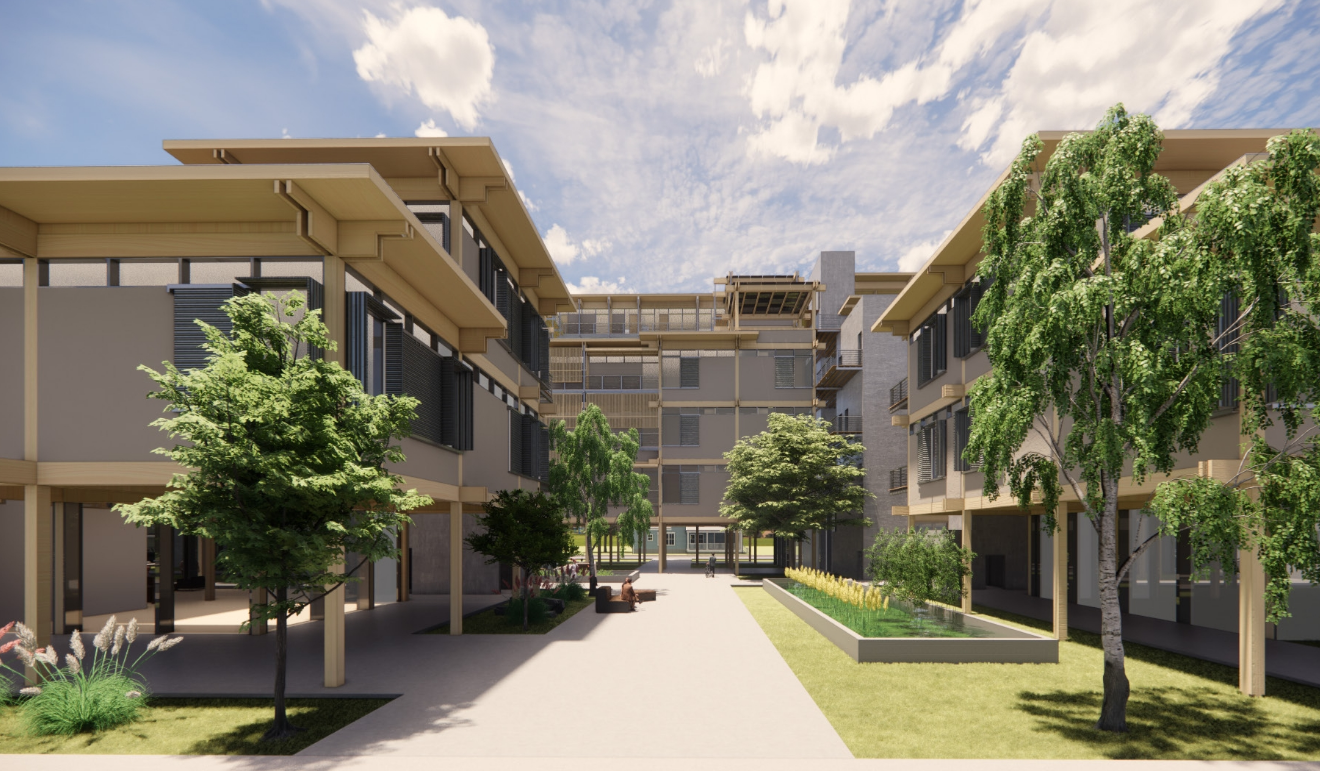
Affordability is one of the most important factors in student housing development, especially in rapidly growing cities with increasing property prices. Beyond economic aspects, student housing needs to focus on environmental issues and community integration to create and maintain sustainability in the long run. ReGen Hall illustrates a unique approach to student housing projects aiming to demonstrate the viability of integrating ecological sustainability and affordability while preserving the community fabric. Located in Austin, Texas, the project incorporates advanced modular construction methods, Passive House design principles, and innovative net-zero energy strategies. This 62,000-square-foot residence hall integrates renewable energy systems, including a 320-kW photovoltaic array and rainwater harvesting infrastructure, to significantly reduce operational emissions and water dependency. Life Cycle Analysis (LCA) of the building carried out over a projected lifespan of 100 years reveals a carbon footprint of 2,853 tons of CO2e. This analysis is calculated using verified data from One Click LCA and industry benchmarks to ensure rigorous methods. Economic evaluations show cost reductions through modular construction, bringing total project expenses well below local benchmarks. Moreover, community-focused design elements, such as shared spaces, green courtyards, and a free medical clinic, foster social cohesion while meeting the housing needs of a diverse student population. Employing a quantitative research approach and spatial analysis, this study evaluates the environmental, economic, and social impacts of ReGen Hall. The findings demonstrate that sustainable technologies can effectively balance affordability and environmental stewardship and offer a model for future student housing developments.
Abiodun Benedict Adeyemi, Tochi Chimaobi Ohakawa, Azubuike Chukwudi Okwandu, Obinna Iwuanyanwu, and Gil-Ozoudeh Ifechukwu. 2024. “Integrating Modular and Prefabricated Construction Techniques in Affordable Housing: Architectural Design Considerations and Benefits.” Comprehensive Research and Reviews in Science and Technology 2 (1): 10–19. Comprehensive Research and Reviews Publishers. https://doi.org/10.57219/crrst.2024.2.1.0030.
Alamel, Alexis. 2015. An Integrated Perspective of Student Housing Supply and Demand: Sustainability and Socio-Economic Differences. PhD diss., Loughborough University.
Arredondo, Diana Angelica. 2023. Tiny Homes: An Innovative Design Solution to Community College Student Housing Insecurity. EdD diss., San Diego State University.
Asmar, Mounir El, and Claire Tilton. 2015. “Student Housing Energy Consumption: A Comparison of Chilled Water, Heating, and Electricity Use.” Procedia Engineering 118: 1038–43. Elsevier. https://doi.org/10.1016/j.proeng.2015.08.546.
Austin Energy. 2023. “Solar Photovoltaics (PV) Rebate & Incentives.” Accessed December 18, 2023. https://austinenergy.com/green-power/solar-solutions/for-your-multifamily/solar-photovoltaic-pv-incentives.
Borghi, Adriana Del, Thomas Spiegelhalter, Luca Moreschi, and Michela Gallo. 2021. “Carbon-Neutral-Campus Building: Design versus Retrofitting of Two University Zero Energy Buildings in Europe and in the United States.” Sustainability 13 (16). MDPI. https://doi.org/10.3390/su13169023.
“Community Solar.” 2024. Accessed December 18, 2024. https://www.gosolartexas.org/community-solar.
Cynthia Hou, Huiying, Dadi Zhang, and Joseph H.K. Lai. 2023. “Qualitative and Quantitative Investigation into the Indoor Built Environment of Modular Student Housing: A Multiple-Room Case Study.” Energy and Buildings 280. Elsevier. https://doi.org/10.1016/j.enbuild.2022.112734.
Ehlenz, Meagan M., Sarah L. Mawhorter, and Rolf Pendall. 2024. “The Complexities of Student Housing.” Housing Policy Debate 34 (5): 603–19. Routledge. https://doi.org/10.1080/10511482.2024.2372566.
EPA (U.S. Environmental Protection Agency). 2018. Indoor AirPlus Construction Specifications. Accessed November 20, 2023. https://www.epa.gov/indoorairplus/indoor-airplus-.
Garrison, Michael, Matthew Powell, and Logan M. Rogers. 2023. Dell Medical Student Housing Modular Construction System.
Kim, Mi Kyoung, and Mi Jeong Kim. 2016. “Affordable Modular Housing for College Students Emphasizing Habitability.” Journal of Asian Architecture and Building Engineering 15 (1): 49–56. Architectural Institute of Japan. https://doi.org/10.3130/jaabe.15.49.
Liebersohn, Jack, and Jason Lee. 2023. Affordability in Purpose-Built Student Housing. NMHC Research Foundation. https://www.nmhc.org/research-insight/research-report/student-housing/affordability-in-purpose-built-student-housing/.
Maxwell-Gaines, Richard. 2023b. Texas Manual on Rainwater Harvesting. 4th ed. Austin: Texas Water Development Board.
Mpambane, Sinethemba, Nana Akua Asabea Gyadu-Asiedu, and Clinton Aigbavboa. 2025. “Bibliometric Review of Smart and Sustainable Student Residence Models in Developing Economies.” International Journal for Housing Science and Its Applications 46 (2): 35–47. International Association for Housing Science. https://doi.org/10.70517/ijhsa46204.
NREL (National Renewable Energy Laboratory). 2024. “PVWatts Calculator.” Accessed December 18, 2024. https://pvwatts.nrel.gov/.
“Oak Creek Homes Fort Worth.” 2024. Accessed December 16, 2024. https://oakcreekhomes.com/.
O’Brien, Kim. 2024. “Student Housing Pre-Lease Season Ends Below Year-Ago Record.” RealPage, September 16. https://www.realpage.com/analytics/august-2024-student-housing-update/.
Olanrewaju, S. D., O. S. Adetunji, and T. M. Ogundepo. 2019. “Achieving Energy Efficient Building through Energy Performance Analysis of Building Envelope in Student Housing.” Journal of Physics: Conference Series 1378. Institute of Physics Publishing. https://doi.org/10.1088/1742-6596/1378/4/042023.
OpenStudio. 2024. OpenStudio Energy Modeling Software, Version 3.7.0. National Renewable Energy Laboratory. https://www.openstudio.net/.
Goldrick-Rab, Sara, Lia Sanders, Rachel Staley, and Education Northwest. 2024. Homelessness and Housing Insecurity Among Community College Students. Portland, OR: Education Northwest.
Sotomayor, Luisa, Derya Tarhan, Marcelo Vieta, Shelagh McCartney, and Aida Mas. 2022. “When Students Are House-Poor: Urban Universities, Student Marginality, and the Hidden Curriculum of Student Housing.” Cities 124. Elsevier. https://doi.org/10.1016/j.cities.2022.103572.
Texas Water Development Board. 2006. Rainwater Harvesting in Texas. Austin: Texas Water Development Board.
The Luxury Playbook. 2024. “Austin Housing Market Analysis & Forecast (2024–2025).” November. https://theluxuryplaybook.com/austin-housing-market-analysis-forecast-2024-2025/.
U.S. News & World Report. n.d. “University of Texas at Austin: Housing & Campus Life.” Accessed November 16, 2025. https://www.usnews.com/.
Copyright (c) 2026 Saba Abdolshahi

This work is licensed under a Creative Commons Attribution-NonCommercial-ShareAlike 4.0 International License.
Authors who publish with this journal agree to the following terms:
- Authors retain copyright and grant the journal right of first publication with the work simultaneously licensed under a Creative Commons Attribution License that allows others to share the work with an acknowledgement of the work's authorship and initial publication in this journal which is under a Attribution-NonCommercial-ShareAlike 4.0 International license (CC BY-NC-SA 4.0).
- Authors are able to enter into separate, additional contractual arrangements for the non-exclusive distribution of the journal's published version of the work (e.g., post it to an institutional repository or publish it in a book), with an acknowledgement of its initial publication in this journal.
- Authors are permitted and encouraged to post their work online (e.g., in institutional repositories or on their website) prior to and during the submission process, as it can lead to productive exchanges, as well as earlier and greater citation of published work (See The Effect of Open Access).