Artificial Intelligence in Design Education
A Systematic Review and CIDA-Aligned Framework for Interior Architecture and Design

Downloads
Background: Generative Artificial Intelligence (AI) is rapidly becoming integral to design practice, yet its integration into interior architecture and design education faces challenges, creating a potential gap between academic preparation and industry needs. There is an urgent need for evidence-based strategies to integrate AI effectively while upholding core pedagogical values.
Objective: This study systematically reviews recent literature on AI integration in interior architecture and design education to identify current patterns, pedagogical models, challenges, and opportunities, with specific implications for CIDA-accredited interior architecture and design programs.
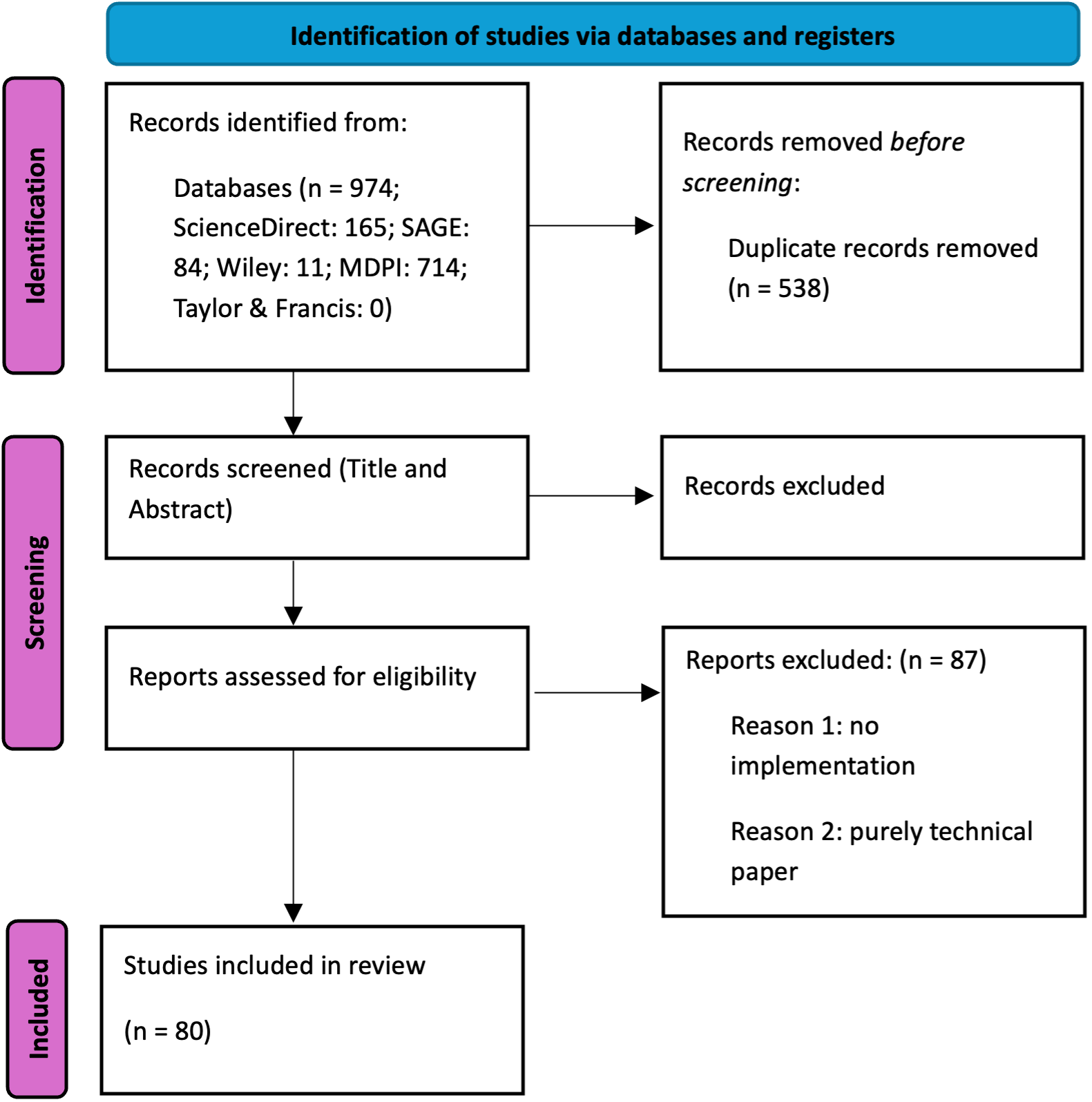
Methods: Following PRISMA 2020 guidelines, the author searched five databases (2021–2025) and screened records based on pre-defined eligibility criteria. Data from 80 included peer-reviewed studies were extracted and synthesized using thematic analysis, guided by postdigital pedagogy and human-centricity lenses.
Results: Eight key themes emerged: (1) AI use is heavily concentrated in early design phases; (2) integration paradoxically reinforces the need for human-centric skills and judgment; (3) literacy demands are evolving from prompt fluency toward broader AI literacy; (4) pedagogical models are diversifying but often lack formal structure; (5) AI's role is expanding beyond generation to analysis and critique; (6) AI increasingly operates within larger technological ecosystems; (7) a quantifiable education-practice gap persists, particularly in later design phases; (8) Affective factors (motivation, anxiety) significantly influence adoption.
Conclusion: AI in interior architecture and design education is advancing fastest in early ideation but remains comparatively underdeveloped in later, standards-intensive phases, indicating that the central curricular challenge is not whether to adopt AI, but how to position, bound, and assess it so that it strengthens auditable human judgment. In response, this paper proposes a CIDA-aligned curricular framework and phased implementation roadmap that link early creative leverage to later-stage rigor through phase-aware AI roles, transparency artifacts, ecosystem thinking, and human-centered evaluation.
Abdallah, Yomna K. 2025. “Designing for Special Neurological Conditions: Architecture Design Criteria for Anti-Misophonia and Anti-ADHD Spaces for Enhanced User Experience.” Architecture 5 (4): 85. https://doi.org/10.3390/architecture5040085.
Abouelela, Amira S., Khaled Al-Saud, Ismail Mahmoud, Dalia Ali Abdel Moneim, Rommel AlAli, and May A. Malek Ali. 2025. “Towards a Sustainable Cultural Identity for Arabic Calligraphy in Furniture Design Through Artificial Intelligence Applications.” Sustainability 17 (9): 4047. https://doi.org/10.3390/su17094047.
Albadrani, Mohammed A. 2025. “Enriching Urban Life with AI and Uncovering Creative Solutions: Enhancing Livability in Saudi Cities.” Sustainability 17 (14): 6603. https://doi.org/10.3390/su17146603.
Alnaser, Aljawharah A., Jamil Binabid, and Samad M. E. Sepasgozar. 2024. “Transforming Architectural Programs to Meet Industry 4.0 Demands: SWOT Analysis and Insights for Achieving Saudi Arabia’s Strategic Vision.” Buildings 14 (12): 4005. https://doi.org/10.3390/buildings14124005.
Çelik, Tuğçe. 2025. “The Effect of Artificial Intelligence on Creativity in Conceptual Design in Architectural Education: The Motion of Biomimetics and Futurism.” AI & SOCIETY 40 (4): 2717–27. https://doi.org/10.1007/s00146-024-02042-7.
Dogru, Tarik, Nathan Line, Makarand Mody, et al. 2025. “Generative Artificial Intelligence in the Hospitality and Tourism Industry: Developing a Framework for Future Research.” Journal of Hospitality & Tourism Research 49 (2): 235–53. https://doi.org/10.1177/10963480231188663.
Fitriawijaya, Adam, and Taysheng Jeng. 2024. “Integrating Multimodal Generative AI and Blockchain for Enhancing Generative Design in the Early Phase of Architectural Design Process.” Buildings 14 (8): 2533. https://doi.org/10.3390/buildings14082533.
Ghanbaripour, Amir Naser, Nima Talebian, Dane Miller, et al. 2024. “A Systematic Review of the Impact of Emerging Technologies on Student Learning, Engagement, and Employability in Built Environment Education.” Buildings 14 (9): 2769. https://doi.org/10.3390/buildings14092769.
Gu, Ning, and Peiman Amini Behbahani. 2021. “A Critical Review of Computational Creativity in Built Environment Design.” Buildings 11 (1): 29. https://doi.org/10.3390/buildings11010029.
Gür, Miray, and Ilker Karadag. 2024. “Machine Learning for Pedestrian-Level Wind Comfort Analysis.” Buildings 14 (6): 1845. https://doi.org/10.3390/buildings14061845.
He, Wei, and Mingze Chen. 2024. “Advancing Urban Life: A Systematic Review of Emerging Technologies and Artificial Intelligence in Urban Design and Planning.” Buildings 14 (3): 835. https://doi.org/10.3390/buildings14030835.
Huh, Michelle Boyoung, Marjan Miri, and Torrey Tracy. 2025. “Students’ Perceptions of Generative AI Image Tools in Design Education: Insights from Architectural Education.” Education Sciences 15 (9): 1160. https://doi.org/10.3390/educsci15091160.
Ishizawa, Tsukasa. 2025. “Architectural Informatics Self-Hackathon Workshop — Reassessing Professional Essence through Generic and Generative Artificial Intelligence.” International Journal of Architectural Computing, April 24, 14780771251335108. https://doi.org/10.1177/14780771251335108.
Jang, Suhyung, Hyunsung Roh, and Ghang Lee. 2025. “Generative AI in Architectural Design: Application, Data, and Evaluation Methods.” Automation in Construction 174 (June): 106174. https://doi.org/10.1016/j.autcon.2025.106174.
Jiang, Bin. 2025. “Beautimeter: Harnessing GPT for Assessing Architectural and Urban Beauty Based on the 15 Properties of Living Structure.” AI 6 (4): 74. https://doi.org/10.3390/ai6040074.
Jin, Shitao, Huijun Tu, Jiangfeng Li, et al. 2024. “Enhancing Architectural Education through Artificial Intelligence: A Case Study of an AI-Assisted Architectural Programming and Design Course.” Buildings 14 (6): 1613. https://doi.org/10.3390/buildings14061613.
Kalleya, Calista, Andi Pramono, Chelsea Putri Angelina, Wilbert Alvin Cuarista, Riefky Prabowo, and Fairuz Iqbal Maulana. 2024. “An Innovative Artificial Intelligence-Based Visualization and Rendering for e-Commerce Startup Booth Design.” Procedia Computer Science 245: 147–54. https://doi.org/10.1016/j.procs.2024.10.238.
Karadağ, Derya, and Betül Ozar. 2025. “A New Frontier in Design Studio: AI and Human Collaboration in Conceptual Design.” Frontiers of Architectural Research, March, S2095263525000226. https://doi.org/10.1016/j.foar.2025.01.010.
Kim, Ji-Yeon, and Sung-Jun Park. 2025. “AI-Driven Biophilic Façade Design for Senior Multi-Family Housing Using LoRA and Stable Diffusion.” Buildings 15 (9): 1546. https://doi.org/10.3390/buildings15091546.
Kołata, Joanna, and Piotr Zierke. 2021. “The Decline of Architects: Can a Computer Design Fine Architecture without Human Input?” Buildings 11 (8): 338. https://doi.org/10.3390/buildings11080338.
Komatina, Dragan, Mirjana Miletić, and Marija Mosurović Ružičić. 2024. “Embracing Artificial Intelligence (AI) in Architectural Education: A Step towards Sustainable Practice?” Buildings 14 (8): 2578. https://doi.org/10.3390/buildings14082578.
Leibowitz, Vicki, Cristina Garduño Freeman, and Lucila Carvalho. 2025. “Chatting with DALL-E in a Postdigital Architectural Classroom.” Postdigital Science and Education 7 (3): 965–84. https://doi.org/10.1007/s42438-025-00576-7.
Li, Yashuai, Wubin Wang, Jichang Zhao, et al. 2025. “Estimating Demolition Waste from Residential Interior Photos: A Large Language Model Solution.” Automation in Construction 179 (November): 106478. https://doi.org/10.1016/j.autcon.2025.106478.
Liu, Baochang, Wenli Wang, Xiaoyu Liu, and Jie Wu. 2024. “Research on Innovative Design of Interactive Learning Environment for Architectural Education Integrating Artificial Intelligence and Virtual Reality Technology.” Applied Mathematics and Nonlinear Sciences 9 (1): 20243001. https://doi.org/10.2478/amns-2024-3001.
Meng, Jingting, Xingjia Fang, Jian Xu, and Ziqi Zhang. 2025. “Research on the Innovative Application of Song Dynasty Boundary Painting in Interior Soft Decoration Design Based on AIGC.” Buildings 15 (7): 1067. https://doi.org/10.3390/buildings15071067.
Montenegro, Nuno. 2024. “Integrative Analysis of Text-to-Image AI Systems in Architectural Design Education: Pedagogical Innovations and Creative Design Implications.” Journal of Architecture and Urbanism 48 (2): 109–24. https://doi.org/10.3846/jau.2024.20870.
Öztürk, Sezer Volkan, and Ayşegül Durukan. 2025. “Unseen Needs: The Imperative of Building Biology-Based Design in Educational Spaces for Individuals with Down Syndrome.” Buildings 15 (17): 3016. https://doi.org/10.3390/buildings15173016.
Page, Matthew J., David Moher, Patrick M. Bossuyt, et al. 2021. “PRISMA 2020 Explanation and Elaboration: Updated Guidance and Exemplars for Reporting Systematic Reviews.” BMJ, March 29, n160. https://doi.org/10.1136/bmj.n160.
Patil, Madhavi P., and Ashraf M. Salama. 2024. “Shaping a Future Research Agenda across Diverse Knowledge Spaces in Architecture and Urbanism – through the Lens of Archnet-IJAR.” Archnet-IJAR: International Journal of Architectural Research 18 (4): 693–718. https://doi.org/10.1108/ARCH-10-2024-0450.
Petrova, Miroslava, and Claas Kuhnen. 2025. “Artificial Intelligence as a Tool for Individual and Collaborative Creativity in Design Education.” Design and Technology Education: An International Journal 30 (1): 86–101. https://doi.org/10.24377/DTEIJ.ARTICLE3044.
Postle, Bruno, and Nikos A. Salingaros. 2025. “LLM and Pattern Language Synthesis: A Hybrid Tool for Human-Centered Architectural Design.” Buildings 15 (14): 2400. https://doi.org/10.3390/buildings15142400.
Salingaros, Nikos A. 2025. “Façade Psychology Is Hardwired: AI Selects Windows Supporting Health.” Buildings 15 (10): 1645. https://doi.org/10.3390/buildings15101645.
Şekerci, Yaren, Mehmet Uğur Kahraman, and Müge Develier. 2023. “Enhancing Interior Design Education with Artificial Intelligence: A Multisensory Hotel Design.” Interiors 13 (2–3): 195–229. https://doi.org/10.1080/20419112.2024.2409504.
Shaikh, Tawseef Ayoub, Tabasum Rasool, and Waseem Ahmad Mir. 2025. “Fields of the Future: Digital Transformation in Smart Agriculture with Large Language Models and Generative AI.” Computer Standards & Interfaces 94 (August): 104005. https://doi.org/10.1016/j.csi.2025.104005.
Shen, Qinjie. 2025. “Artificial Intelligence as a Pedagogical Communicator: Mixed-Methods Insights from Raffles International College Bangkok.” Computers and Education Open 9 (December): 100297. https://doi.org/10.1016/j.caeo.2025.100297.
Soulikias, Aristofanis, Carmela Cucuzzella, Firdous Nizar, Morteza Hazbei, and Sherif Goubran. 2021. “We Gain a Lot…but What Are We Losing? A Critical Reflection on the Implications of Digital Design Technologies.” Open House International 46 (3): 444–58. https://doi.org/10.1108/OHI-02-2021-0041.
Sukkar, Ahmad W., Mohamed W. Fareed, Moohammed Wasim Yahia, Emad Mushtaha, and Sami Luigi De Giosa. 2024. “Artificial Intelligence Islamic Architecture (AIIA): What Is Islamic Architecture in the Age of Artificial Intelligence?” Buildings 14 (3): 781. https://doi.org/10.3390/buildings14030781.
Tang, Ming, Mikhail Nikolaenko, Ahmad Alrefai, and Aayush Kumar. 2025. “Metaverse and Digital Twins in the Age of AI and Extended Reality.” Architecture 5 (2): 36. https://doi.org/10.3390/architecture5020036.
Wang, Jiaqi, Yu Shi, Xiang Chen, Yi Lan, and Shuying Liu. 2025. “Teaching with Artificial Intelligence in Architecture: Embedding Technical Skills and Ethical Reflection in a Core Design Studio.” Buildings 15 (17): 3069. https://doi.org/10.3390/buildings15173069.
Wang, Kai, Wencheng Cui, and Xue Yuan. 2025. “Artificial Intelligence in Higher Education: The Impact of Need Satisfaction on Artificial Intelligence Literacy Mediated by Self-Regulated Learning Strategies.” Behavioral Sciences 15 (2): 165. https://doi.org/10.3390/bs15020165.
Wang, Yao, Yiting Zhao, Xin Tian, Jiachen Yang, and Shijian Luo. 2025. “The Influence of Subjective Knowledge, Technophobia and Perceived Enjoyment on Design Students’ Intention to Use Artificial Intelligence Design Tools.” International Journal of Technology and Design Education 35 (1): 333–58. https://doi.org/10.1007/s10798-024-09897-3.
Wu, Jing-Wen, and Ming-Hseng Tseng. 2025. “Developing a Local Generative AI Teaching Assistant System: Utilizing Retrieval-Augmented Generation Technology to Enhance the Campus Learning Environment.” Electronics 14 (17): 3402. https://doi.org/10.3390/electronics14173402.
Zahra, Samer, Medhat Samra, and Lamis El Gizawi. 2025. “Working Toward Advanced Architectural Education: Developing an AI-Based Model to Improve Emotional Intelligence in Education.” Buildings 15 (3): 356. https://doi.org/10.3390/buildings15030356.
Zeng, Shaoting, Suihong Lan, Zhengwen Xu, et al. 2025. “Research on Human-Machine Collaborative Innovation Methods in Design Education Inspired by the Learning Mechanism of Generative Adversarial Networks.” Design and Artificial Intelligence 1 (2): 100020. https://doi.org/10.1016/j.daai.2025.100020.
Zhang, Baizhou, Yichen Mo, and Biao Li. 2025. “Web-Based Computational Design Tools for Architectural Design Studio: Enhancing Pedagogical Framework.” Nexus Network Journal 27 (3): 663–80. https://doi.org/10.1007/s00004-025-00826-y.
Copyright (c) 2026 Jinoh Park

This work is licensed under a Creative Commons Attribution-NonCommercial-ShareAlike 4.0 International License.
Authors who publish with this journal agree to the following terms:
- Authors retain copyright and grant the journal right of first publication with the work simultaneously licensed under a Creative Commons Attribution License that allows others to share the work with an acknowledgement of the work's authorship and initial publication in this journal which is under a Attribution-NonCommercial-ShareAlike 4.0 International license (CC BY-NC-SA 4.0).
- Authors are able to enter into separate, additional contractual arrangements for the non-exclusive distribution of the journal's published version of the work (e.g., post it to an institutional repository or publish it in a book), with an acknowledgement of its initial publication in this journal.
- Authors are permitted and encouraged to post their work online (e.g., in institutional repositories or on their website) prior to and during the submission process, as it can lead to productive exchanges, as well as earlier and greater citation of published work (See The Effect of Open Access).